


10 Ecommerce Integrations Every Ecommerce Business Needs to Scale

Scaling an ecommerce business is no longer just about adding more products or running ads. To grow sustainably, you need the right ecommerce integrations that automate operations, improve customer experience, and give you real-time insights.
Whether you're running Shopify, WooCommerce, Magento, or a custom ecommerce platform, these integrations are essential if you want to scale without chaos.
1. Payment Gateway Integration
A seamless payment experience directly impacts conversions. Multiple payment options build trust and reduce cart abandonment.
- ✅ Razorpay / Stripe / PayPal
- ✅ UPI, cards, wallets & BNPL options
- ✅ Secure & PCI-compliant checkout
2. Inventory Management Integration
Manual stock handling doesn’t scale. Inventory integrations help you track stock levels across warehouses and platforms in real time.
Why it matters: Prevents overselling, stockouts, and order delays.
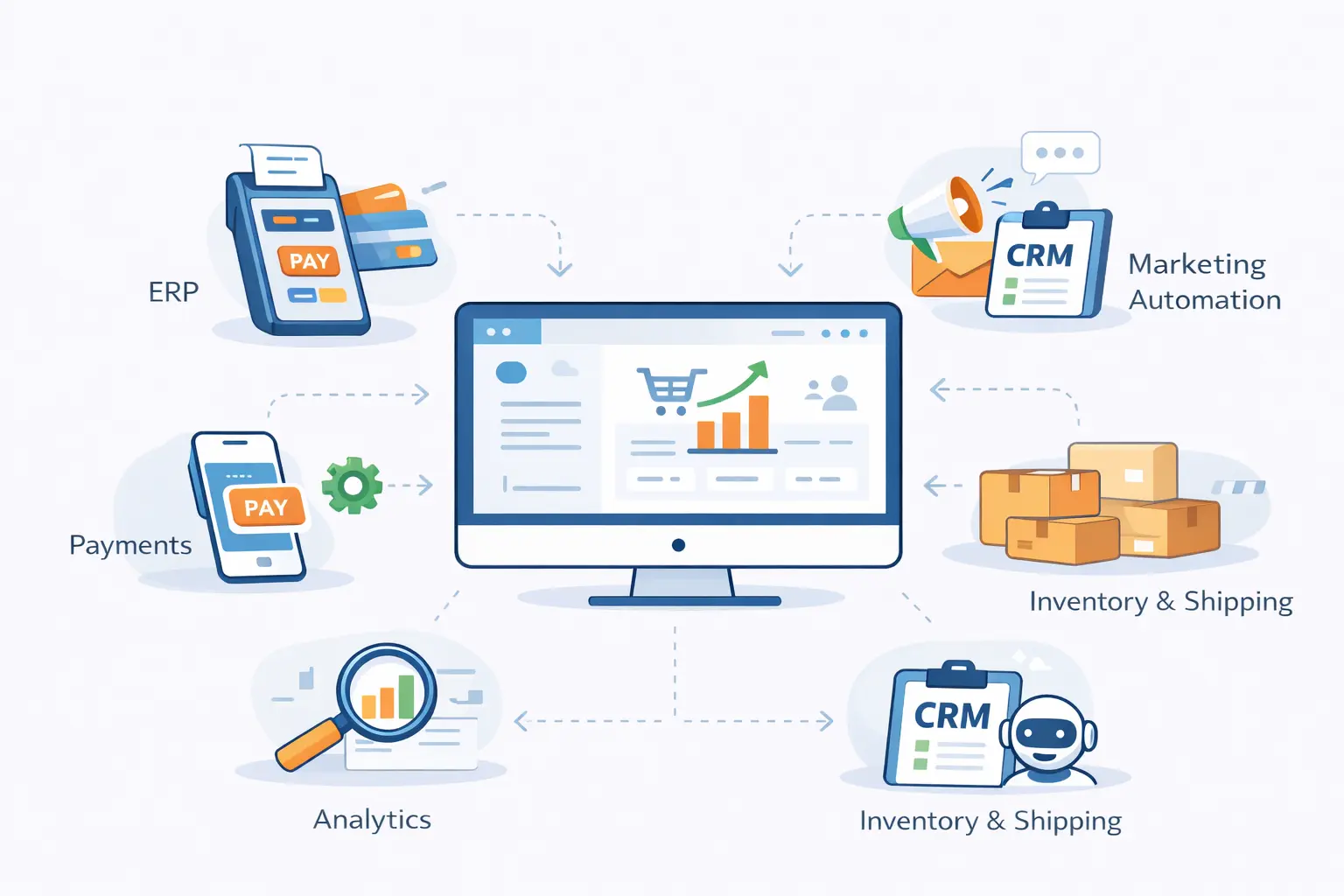
3. Shipping & Logistics Integration
Fast and transparent delivery is a competitive advantage. Logistics integrations automate shipping labels, tracking, and delivery updates.
- ✅ Shiprocket, Delhivery, FedEx
- ✅ Auto order fulfillment
- ✅ Real-time tracking for customers
4. CRM Integration
A CRM helps you understand who your customers are, what they buy, and how often they return.
Integrating CRM with your ecommerce store enables personalized communication, better support, and higher customer lifetime value.
5. Marketing Automation Integration
Scaling manually-run campaigns is impossible. Marketing automation lets you engage customers automatically at the right time.
- ✅ Abandoned cart emails
- ✅ Product recommendation emails
- ✅ WhatsApp & SMS automation
6. Analytics & Reporting Integration
You can’t scale what you don’t measure. Analytics integrations give insights into traffic, conversions, and customer behavior.
Tools like: Google Analytics, GA4, Mixpanel, custom dashboards
7. Accounting & GST Integration
Financial accuracy becomes critical as orders grow. Accounting integrations automate invoicing, tax calculations, and reports.
This saves hours of manual work and reduces compliance errors.
8. Customer Support Integration
As order volume increases, so do customer queries. Support integrations centralize chats, emails, and tickets.
- ✅ Live chat & chatbots
- ✅ Helpdesk systems
- ✅ Faster issue resolution
9. ERP Integration
For mid to large ecommerce businesses, ERP integration connects inventory, accounting, procurement, and operations in one system.
This is a game-changer for scalability and operational clarity.
10. AI & Recommendation Engine Integration
AI-powered integrations personalize the shopping experience by recommending products based on user behavior.
Result: Higher average order value and better customer retention.
Final Thoughts: Integrations = Scalable Growth
Ecommerce businesses that scale successfully don’t work harder — they work smarter. The right integrations reduce manual effort, improve accuracy, and create a seamless experience for customers.
If your ecommerce store is struggling with growth, operations, or automation, the problem is usually not traffic — it’s missing integrations.
Need help integrating or scaling your ecommerce platform?
Let’s build a future-ready ecommerce system tailored for growth.